
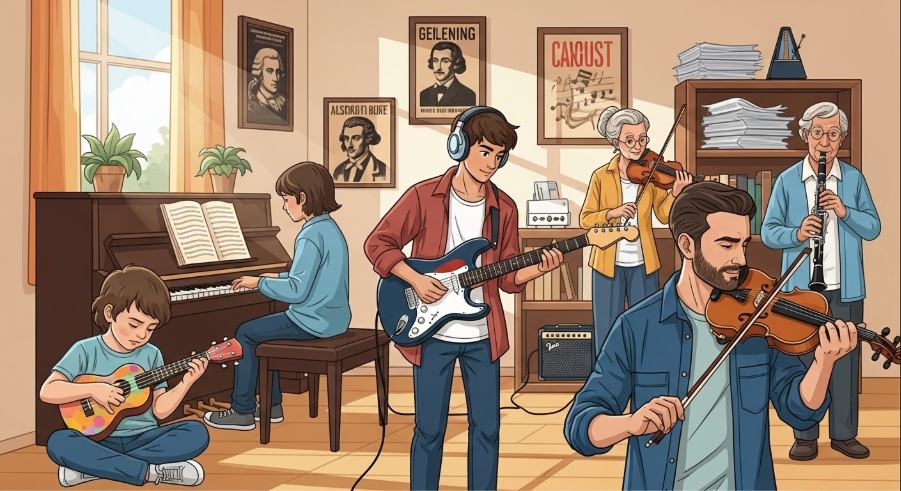
“My daughter’s only three, is it too soon for piano lessons?” “My son’s already seven. Have we missed the window for violin?” Questions around what is the best age to start music lessons are ones that we hear constantly from parents at Bumblebee Centre, and here’s the honest answer: there’s no single “right age” to start music lessons. But there are smart ages for different instruments, and understanding your child’s readiness matters far more than hitting an arbitrary number.
A 2025 review published in the Australian Journal of Music Education examined music learning programmes across Australian schools and found that music education supports children’s wellbeing across individual, social, and educational outcomes. The research reported that all but one source confirmed music learning supported children’s development and well-being. But forcing a three-year-old into formal lessons when they’re not ready? That can backfire completely.
Age Guidelines by Instrument:
- Piano lessons: Most children are ready between 5-7 years (some as early as 4 with the right temperament)
- Guitar lessons: Age 6-8 works best for most kids (physical hand size matters here)
- Violin lessons: Can start as young as 3-4 with specialised methods like Suzuki
- Drum lessons: Age 506 minimum for coordination; 7-8 is more common
- Group music classes: From 18 months onwards for music exploration (not formal instrument training)
What Matters More Than Age
Your child’s physical and emotional readiness trumps their birthday every time. A mature five-year-old might thrive in piano lessons, whilst a distracted seven-year-old might need another year.
Watch for these signs:
- Can they sit still for 10-15 minutes?
- Do they show curiosity about sounds or music?
- Can they follow two-step instructions reliably?
These matter more than whether they’ve turned six yet.
Hand size plays a practical role, too. A four-year-old’s fingers often struggle to press piano keys properly or form guitar chords. We’ve seen plenty of eager kids get frustrated not because they lack musical ability, but because their hands simply aren’t big enough yet.
What Age to Start Piano Lessons?
Piano is brilliant for beginners – keys are right there in front of you, cause and effect is immediate, and you’re building foundation skills that transfer to any instrument later.
Most children are physically and mentally ready for piano lessons between the ages of 5 and 7. At five, kids typically have the hand span to reach keys comfortably and the attention span for 15-20 minute lessons. Some four-year-olds manage beautifully if they’re naturally focused, but this isn’t the norm.
Starting at age 6 or 7 often means faster progress because cognitive skills are more developed. Your child can read basic notation sooner, understand rhythm concepts better, and practise more independently.
But here’s what we tell worried parents: an eight-year-old beginner isn’t “behind.” They’ll likely catch up to (and sometimes overtake) younger starters within a year because their brain processes information more efficiently.
What Age to Start Guitar Lessons?
Guitar requires more physical strength and coordination than piano. Those steel or nylon strings need finger pressure, chord shapes demand hand stretching, and holding the instrument itself takes arm strength.
The best age to start guitar lessons is typically 6-8 years. By age six, most children have developed enough finger strength and hand size to form basic chords on a 3/4-size guitar (a properly sized instrument makes all the difference; don’t hand your six-year-old a full-size adult guitar).
Seven- or eight-year-olds often find the guitar more immediately rewarding because they can handle chord changes more quickly and have the patience for the initial finger soreness that comes with building calluses.
For younger children fascinated by the guitar, a ukulele makes an excellent stepping stone from age 4-5. Smaller, easier to hold, softer strings, and simpler chord shapes mean early success, which builds the confidence and skills they’ll later transfer to guitar.
What Age Can You Start Violin Lessons?
Violin is unique because specialised teaching methods like the Suzuki method were designed specifically for very young children. Kids as young as 3-4 can start violin lessons using these approaches, which emphasise learning by ear, parent involvement, and appropriately sized instruments.
That said, starting violin at age 3 requires significant parental commitment. You’re attending lessons together, guiding daily practice, and essentially learning alongside your child. If that level of involvement doesn’t suit your family, waiting until age 5-6, when children can be more independent, works just as well.
The best age to start violin lessons really depends on your family setup. Early starters (3-5 years) develop incredible ear training but need hands-on support. Later starters (6-8 years) progress faster with reading music but might need more help with bowing technique initially.
Physical fit matters enormously, violins come in fractional sizes (1/16, 1/10, 1/8, all the way to full size), and your child must have an instrument that matches their body. A violin that’s too large will cause tension and poor posture habits that are hard to correct later.
Good Age to Start Drum Lessons
Drums demand the most coordination of any instrument; your child is literally doing four different things at once (right hand, left hand, right foot, left foot). This makes drums trickier for younger children.
A good age to start drum lessons is typically 6-7 years minimum, though 7-8 is more realistic for most kids. At this age, children have developed enough limb independence to handle basic coordination patterns and the core strength to sit at a kit properly for 20-30 minutes.
Younger children (4-6) who are obsessed with drums can start with percussion exploration in group music classes – rhythm games, hand drums, basic beat-keeping – which builds the foundational skills they’ll need for a full kit later.
Balance and physical stamina matter here, too. Playing drums is active and physical. If your child struggles with activities that require sustained energy and focus, they might find drums exhausting at first.
What Is the Best Age to Start Music Lessons Overall?
If you’re weighing up general music education, ages 4-7 represent a sweet spot for most children and most instruments. But “best” is misleading. What we’ve learned from teaching hundreds of families is that the best age is when your child is genuinely interested and developmentally ready.
Starting music lessons at age four with a child who’s curious and engaged will always beat forcing a “perfect” six-year-old who resents being there. Musical ability develops through consistent, positive practice, and that only happens when children actually want to participate.
Early exposure through music classes in Melbourne builds invaluable skills: rhythm awareness, listening, pitch recognition, and comfort with musical expression. These aren’t formal instrument lessons, but playful, movement-based, and brilliantly effective at preparing young minds for later learning.
The Benefits Go Beyond the Instrument
Children who engage with music develop skills that ripple into every area of life. We see it constantly, kids who start piano lessons at age six show improved mathematical thinking by age eight. Students in our drum lessons programme report better focus at school.
Music builds emotional literacy, too. A child learning violin lessons isn’t just developing bowing technique; they’re learning to express feelings through sound, to listen carefully, to persist through challenges.
And unlike maths homework or spelling tests, music offers a creative outlet children genuinely enjoy. That intrinsic motivation drives practice, which builds discipline, which creates confidence; a cycle that benefits them well into adulthood.
Starting Late Isn’t “Too Late”
One final reassurance for parents worried they’ve missed some critical window: your ten-year-old who suddenly wants guitar lessons isn’t too old. Older beginners often progress faster because they have stronger focus, better fine motor control, and clearer musical goals.
Adults pick up instruments in their thirties, forties, and fifties and thrive. Music isn’t a race with a closing gate at age seven; it’s a lifelong skill that enriches, however and whenever you engage with it.
Ready to Explore Music with Your Child?
There’s no perfect age to start, just the right age for your child. If they’re showing interest, can focus for short periods, and you’re ready to support their learning, it’s worth exploring.
At Bumblebee Centre, we meet families exactly where they are. Whether your three-year-old is fascinated by sounds or your eight-year-old has suddenly decided they want to learn piano, we’ll help you find the right fit. Our experienced teachers understand child development, match teaching styles to individual personalities, and make learning genuinely enjoyable, not a chore.
Book a trial lesson and let’s discover what your child can do with music.
