
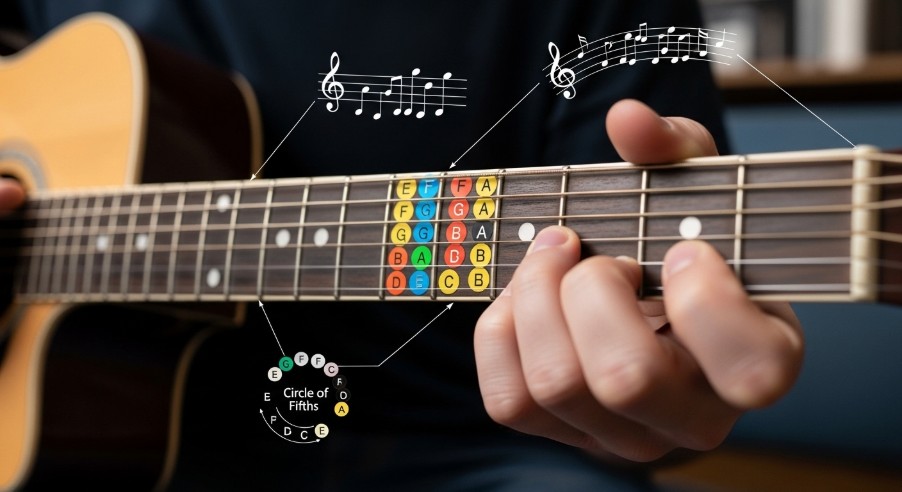
You’ve nailed a few chords, maybe even learned a song or two, but every time someone mentions “the note on the 7th fret” or asks you to improvise, you freeze. Sound familiar?
The good news is that learning the guitar fretboard isn’t some mysterious skill reserved for prodigies — it’s just a system. And once you crack it, everything from writing riffs to jamming with mates becomes exponentially easier.
Quick Tips:
- Master the fretboard by learning natural notes on the low E and A strings first
- Use the CAGED system guitar framework to visualise patterns across the neck
- Octave shapes and anchor points help you navigate without counting frets
- Daily 5-minute drills beat cramming once a week
- Most players memorise guitar fretboard notes within 2-4 weeks using these methods
Why Memorising Guitar Fretboard Notes Matters
Before we jump into the methods, let’s be clear about what you’re gaining. Knowing what note is each fret on a guitar means you can:
- Build chords anywhere on the neck (not just in first position)
- Improvise solos that make sense musically
- Communicate with other musicians (“let’s meet on the 5th fret A”)
- Transpose songs instantly without a capo
Memorising notes and frets unlocks the creative freedom to truly explore music.
Method 1: Start With the Natural Notes (E and A Strings)
Don’t try to learn all six strings at once; that’s where most beginners burn out. Focus on the low E string (6th string) first:
- Open = E
- 3rd fret = G
- 5th fret = A
- 7th fret = B
- 12th fret = E (octave)
Then move onto the A string (5th string):
- Open = A
- 2nd fret = B
- 3rd fret = C
- 5th fret = D
- 7th fret = E
- 12th fret = A (octave)
These two strings are your foundation. Learn them cold before moving on. Most common chord roots sit on these strings, so you’ll use this knowledge constantly.
Practice Drill:
Pick a random fret on the E or A string. Say the note out loud before you play it. Check yourself. Repeat 20 times. Do this daily for a week.
Method 2: Use Octave Shapes to Navigate the Neck
Here’s where the guitar fretboard starts to click. Octaves follow predictable patterns. If you know an E on the 6th string, 7th fret, you can find another E two strings up and two frets higher (5th string, 9th fret).
The two main octave shapes are:
- From 6th string: two strings higher, two frets forward
- From 5th string: two strings higher, three frets forward
Play these shapes up and down the neck. You’ll start seeing notes repeat in familiar positions, and suddenly the fretboard feels smaller.
Method 3: Learn the CAGED System Guitar Framework
The CAGED system guitar method isn’t just about chords – it’s a map of the entire fretboard.
CAGED refers to five open chord shapes: C, A, G, E, D. These shapes repeat up the neck in that exact order. Each shape contains the same notes as its root chord, just in different octaves.
Why this matters for memorising guitar fretboard notes
You already know open chord shapes. CAGED shows you how those same shapes exist everywhere, just barred or repositioned. When you see a G shape at the 10th fret, you know every note in that shape is part of a C chord.
If you’re taking guitar lessons, your teacher will likely introduce CAGED early. It’s one of the fastest ways to connect what you know (open chords) to what you’re learning (fretboard notes).
Method 4: Anchor Points – The Fret Markers Aren’t Random
Those dots on your fretboard (3rd, 5th, 7th, 9th, 12th frets) exist for a reason. Use them as anchor points:
- 3rd fret, 6th string = G
- 5th fret, 6th string = A
- 7th fret, 6th string = B
- 12th fret = octave of the open string (on any string)
Build outward from these anchors. If you know the 5th fret on the E string is A, you can count forward or backward to find nearby notes.
This method works brilliantly when you’re improvising or trying to find a specific note fast — you’re not starting from scratch every time.
Method 5: Say It Out Loud (Seriously)
Want to know the fastest way to burn guitar fretboard notes into your brain?
Speak them aloud.
Don’t just play the note, say it before you hit the string. “5th fret, A string… that’s D.” Then play it. Your brain forms stronger connections when you engage multiple senses.
Do this during warm-ups, practice sessions, even when you’re noodling. It feels awkward at first, but the retention boost is massive.
Method 6: Backwards Drills – Work From the Note, Not the Fret
Most people practice like this: “What’s the note on the 9th fret, D string?”
Flip it.
Start with the note: “Where can I find all the Cs on the fretboard?”
This forces you to visualise the entire neck instead of memorising one string at a time. You’ll discover patterns you’d never notice otherwise – like how C appears on the 3rd fret (A string), 8th fret (E string), and 10th fret (D string).
Bonus: This mirrors how you’ll actually use the fretboard when writing or improvising. You’ll think “I need a G here” and your fingers will know three places to find it.
Method 7: Five Minutes a Day Beats One Hour on Sunday
Consistency demolishes cramming when it comes to how to memorise the fretboard.
Set a timer for 5 minutes. Pick one method from this list (octave shapes, anchor points, backwards drills) and work it. Tomorrow, do it again. The repetition builds neural pathways; your hands will start moving before your brain fully processes the note.
After two weeks of daily 5-minute drills, you’ll notice something: you’re not thinking about fret numbers anymore. You’re just playing.
If you’re juggling school, work, or extra curricular activities, this approach fits. No marathon sessions required, just show up daily.
Common Mistakes That Slow You Down
- Trying to learn all six strings at once. Start with E and A strings. Master those first.
- Skipping the flats and sharps. Yes, they matter. Once you know the natural notes (A, B, C, D, E, F, G), filling in the sharps and flats (like A# or Bb) becomes straightforward—they’re just the frets in between.
- Not using your ears. Play the note, then sing it. Hear the pitch. Fretboard memorisation isn’t just visual, it’s sonic.
Ready to Apply These Tips?
Memorising the guitar fretboard isn’t about talent or photographic memory. It’s about using the right methods and staying consistent.
You’ve now got seven proven techniques. Pick two (E/A string focus + octave shapes work brilliantly together) and commit to 5 minutes daily for the next two weeks. You’ll be shocked at how fast the fretboard becomes second nature.
Looking for structured guidance to accelerate your progress? Our music classes in Melbourne break down fretboard mastery step-by-step, with live feedback from experienced instructors who’ve taught hundreds of players exactly where you are now. Whether you’re 12 or 45, beginner or early-intermediate, our guitar lessons meet you where you are and build real skills fast.
Book your first session at Bumblebee Centre and go from “I think that’s a G?” to confidently navigating the neck, usually within your first month.
