
You’ve nailed that minor pentatonic box. Your blues licks sound solid, your solos have bite – but you’ve hit a wall. Everything’s starting to sound the same, and you know there’s more colour waiting just beyond your fingertips.
Here’s the thing: the pentatonic scale isn’t just one formula. There’s a major and a minor version – and they’re more connected than you think. Once you understand how major and minor pentatonic scales work together, you’ll unlock a completely new palette of sounds without learning hundreds of new patterns.
Quick Answer:
- The same five-note pattern can be either major or minor pentatonic depending on which note you treat as home base (the tonic).
- C major pentatonic and A minor pentatonic share identical notes – just different starting points.
- You can mix both scales over the same chord progression for richer, more expressive solos.
- Start by adding one or two major pentatonic notes into your minor pentatonic licks – don’t try to learn everything at once.
What Makes a Pentatonic Scale Major or Minor?
Here’s where most guitarists get confused, and it’s simpler than you think. The difference between major and minor scales comes down to one thing: which note is home.
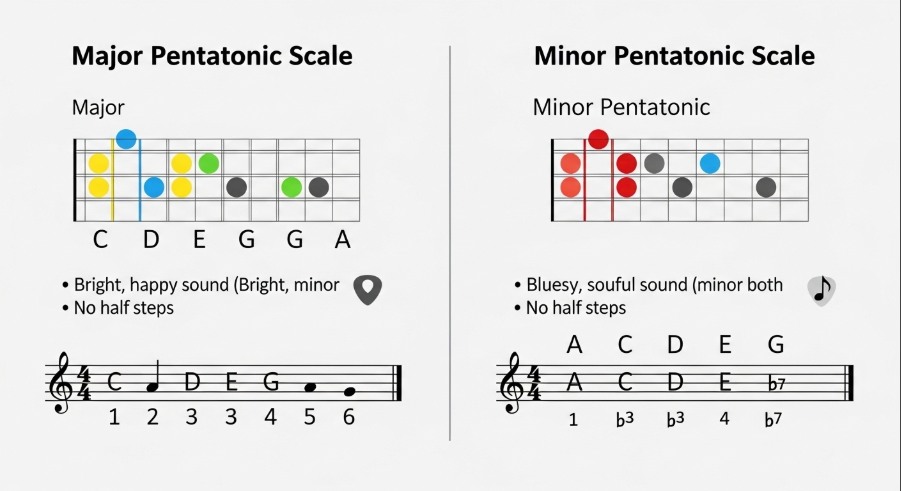
Take the notes C–D–E–G–A. Play those notes and emphasise C as your tonic (your home note)? You’re playing C major pentatonic. Play the exact same five notes but treat A as your root? Now you’re in A minor pentatonic. Same pattern on the fretboard. Same notes under your fingers. Completely different sound.
This is called the relative major/minor relationship. C major and A minor are relatives – they’re made from the same notes, but they orbit different centres of gravity.
The Two Ways to Combine Major and Minor Pentatonic Scales
Right, let’s get practical. There are two main approaches to mixing these scales, and they create very different sounds.
Method 1: Use Relative Major/Minor (Same Notes, Different Patterns)
This is the safer option and perfect when you’re starting out. Let’s say you’re playing in the key of A minor.
You already know A minor pentatonic (A–C–D–E–G). Your relative major is C major pentatonic, which uses the exact same notes. But by visualising both patterns on the fretboard, you give yourself more creative pathways to play those five notes. You’re not learning new notes; you’re learning new routes between the notes you already know.
Try this: Play an A minor backing track. Start with your go-to minor pentatonic box pattern around the 5th fret. Now shift your thinking to the C major pentatonic pattern a few frets up. You’re still playing A–C–D–E–G, but the shapes under your fingers create different melodic options. It’s like walking through the same house but using different doors.
Method 2: Use Parallel Major/Minor (Same Root, Different Notes)
This is where things get spicy. Parallel scales share the same tonic but have different notes. A major pentatonic (A–B–C♯–E–F♯) and A minor pentatonic (A–C–D–E–G) are parallel – both built from A, but with three different notes between them.
When you’re soloing over a blues in A, you can use A minor pentatonic for that gritty, classic blues sound, then sprinkle in notes from A major pentatonic for brightness and lift. This is what you hear in every blues and rock solo that makes you lean forward in your chair.
The major third (C♯ in A major pentatonic) is your secret weapon. Blues and rock guitarists constantly tension between the minor third (C) and major third (C♯), that’s the sound of the blues. Try bending from C up to C♯ over an A7 chord. That half-step bend is pure gold.
How to Start Mixing Without Getting Lost
Don’t try to combine all the notes at once. That’s where most guitarists crash and burn. Here’s the smarter approach:
- Stick with your minor pentatonic. Play a lick you’re comfortable with.
- Identify where the major third lives in relation to your minor pentatonic pattern. In A minor pentatonic around the 5th fret, your minor third (C) is on the 5th fret of the G string. The major third (C♯) is one fret higher – 6th fret, same string.
- Play your lick again, but this time, replace or bend the minor third to the major third. Listen to how that single note changes the whole feel.
- Once that feels natural, start adding the second and sixth notes from the major pentatonic (B and F♯ in the key of A). These create smooth, melodic movement without clashing.
You’re building a hybrid scale – minor pentatonic with major flavours mixed in – not trying to play two separate scales simultaneously.
When to Use Each Sound
- Minor Pentatonic: When you want edge, tension, and classic blues/rock grit. Perfect over minor chords and the I chord in a blues progression.
- Major Pentatonic: When you want brightness, sweetness, and a more country or pop vibe. Works beautifully over major chords and the IV chord in a blues progression.
- Both Mixed: Over-dominant 7th chords (like A7, D7, E7 in a blues). Dominant chords are hybrids themselves – major with a flatted seventh – so they love the tension between major and minor sounds.
The One Practice Exercise That Makes This Click
Here’s what finally made this concept stick for me: pick one position on the fretboard – say, the A minor pentatonic box starting on the 5th fret.
Play through that pattern slowly. Now, without moving your hand position, add only the major third (6th fret, G string). Play around, experimenting with licks that use that single extra note.
Once that feels comfortable, add the major sixth (9th fret, D string). Then the major second (7th fret, A string).
You’re not learning a whole new scale. You’re adding three notes to a pattern you already own. And those three notes give you access to both major and minor pentatonic sounds in the same area of the neck.
Ready to Take Your Solos to the Next Level?
Understanding how major and minor pentatonic scales interact is just the beginning. If you want personalised guidance on applying these concepts to the music you actually want to play – whether that’s blues, rock, jazz, or anything in between – guitar lessons with experienced teachers can fast-track your progress.
At Bumblebee Centre, we teach guitar players exactly where they are right now: past the basics, hungry to break out of the box. Our music classes in Melbourne focus on practical, musical applications of theory – no boring exercises, just real techniques you’ll use in your next jam. We also offer NDIS music lessons for participants who want to develop their musical skills in a supportive, accessible environment.
You’ve already done the hard work learning minor pentatonic patterns. Now you’re just adding three strategic notes to unlock major pentatonic sounds in the same position.
Start small. Pick one lick you love. Add the major third. Hear the difference. Then build from there. The goal isn’t to memorise more patterns, it’s to make more music with the patterns you already know.
